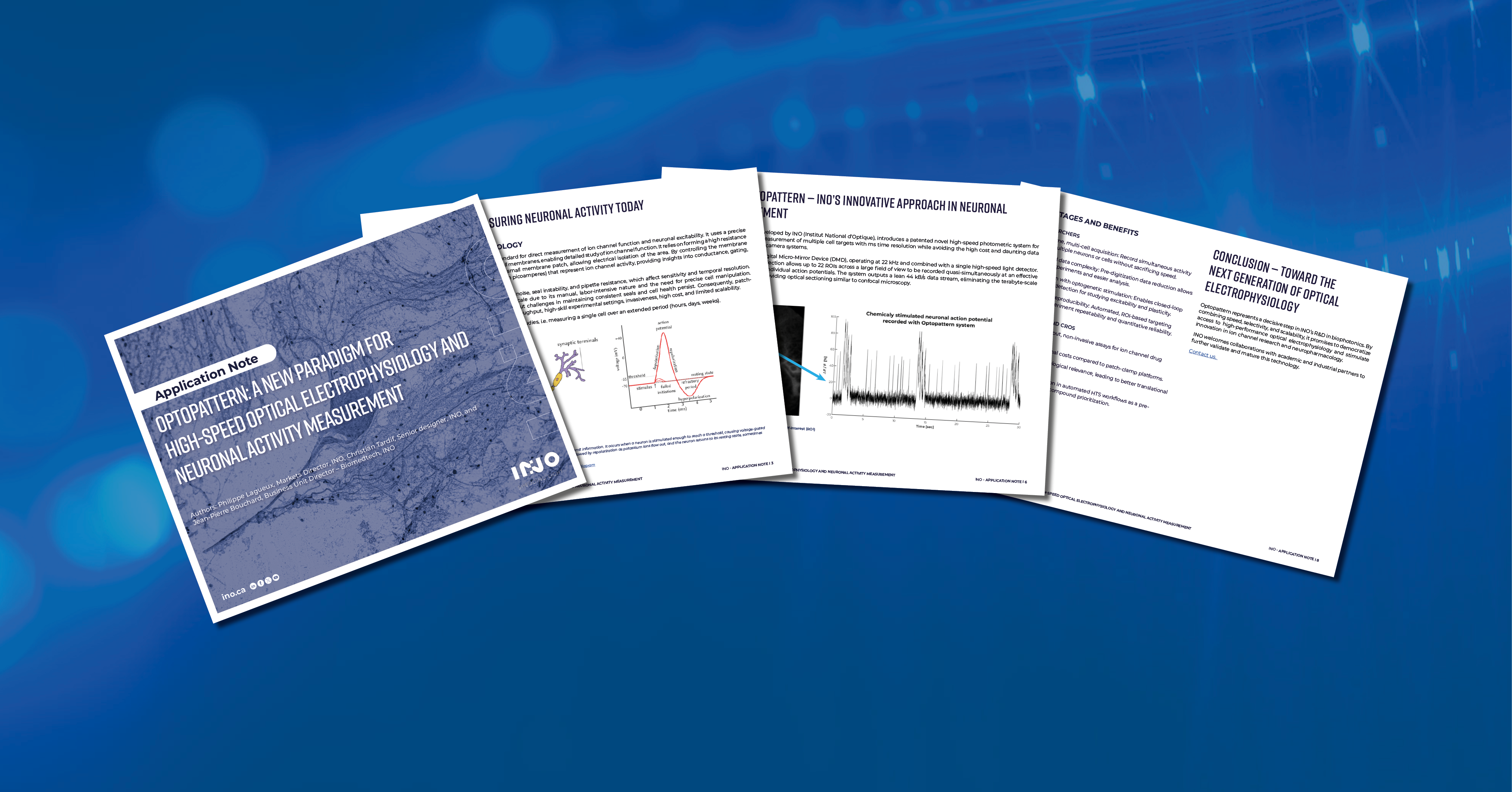
Optogenetics has transformed neuroscience by enabling optical control and measurement of neuronal activity with millisecond precision. However, current high-speed imaging systems rely on complex scientific cameras that generate massive data streams and increase system cost and complexity.
Optopattern, currently developed by INO, introduces a patented high-speed photometric approach designed to measure multiple targets in real time while drastically reducing data output.
This application note presents:
- The limitations of traditional patch-clamp electrophysiology
- The evolution of optogenetics and optical voltage sensing
- The instrumentation challenges of high-speed optical recording
- How Optopattern redefines neuronal activity measurement
Download the application note to learn how INO is establishing a new paradigm in scalable, non-invasive optical electrophysiology.
From Patch-Clamp to Optical Electrophysiology
Patch-clamp remains the gold standard for direct ion-channel and excitability measurements, but it is invasive, technically demanding, and hard to scale. Optogenetics enables non-invasive multi-cell recording in more natural conditions but typically relies on high-speed cameras and intensive data handling.
Why does optical electrophysiology need a new instrumentation approach?
Voltage imaging requires millisecond-scale acquisition with high signal fidelity. In practice, the bottleneck is often not biology — it’s instrumentation: camera cost, optical complexity, and terabyte-scale data streams.
Therefore, a next-generation platform must combine:
- millisecond time resolution
- multi-cell acquisition (multiple targets at once)
- low data output for long experiments and faster analysis
- compatibility with optogenetic stimulation for closed-loop studies
Optopattern: INO’s patented high-speed photometric system
Optopattern is based on a Digital Micro-Mirror Device (DMD) operating at 22 kHz and a single high-speed photodetector. Instead of recording full-frame images, Optopattern dynamically selects Regions of Interest (ROIs) and measures them quasi-simultaneously.
With Optopattern, you can:
- record up to 22 ROIs across a large field of view
- achieve an effective 1 kHz per ROI (action potential–level timing)
- reach <1 ms resolution with fewer ROIs
- output a lean ~44 kB/s data stream
- reduce camera-driven data burden while preserving temporal fidelity
What You’ll Learn in the Application Note
- How DMD-based photometric detection replaces high-speed imaging
- How 22 ROIs can be measured quasi-simultaneously at 1 kHz
- How Optopattern enables scalable, closed-loop optogenetic experiments
- How INO is advancing next-generation biophotonics instrumentation
Technical Level

Frequently Asked Questions
What is optical electrophysiology?
Optical electrophysiology uses genetically encoded or dye-based voltage indicators to measure membrane potential changes through fluorescence instead of direct electrical contact.
How does Optopattern differ from camera-based optogenetics?
Instead of capturing full-frame high-speed images, Optopattern uses a DMD to selectively address Regions of Interest and records signals with a single high-speed detector, dramatically reducing data volume.
Can Optopattern resolve individual action potentials?
Yes. With an effective 1 kHz per ROI sampling rate, Optopattern can resolve single neuronal action potentials.
Is Optopattern invasive?
No. It is fully optical and preserves natural cellular conditions.
Who is Optopattern designed for?
Neuroscience researchers, drug discovery teams, CROs, and organizations developing high-content neuronal assays.