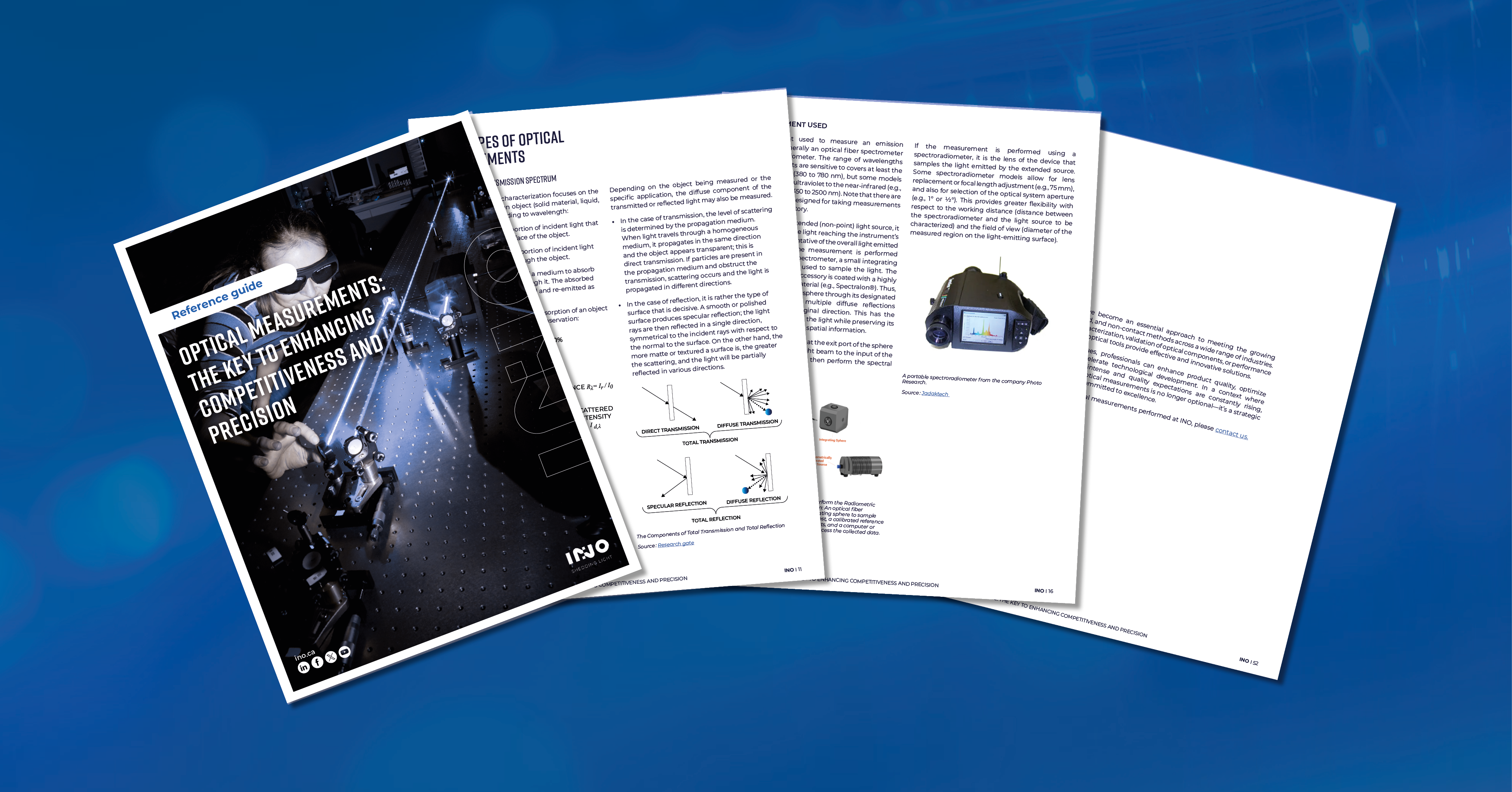
Optical measurements make it possible to characterize light and matter with unmatched precision, non-contact, and in real time. Today, they are essential for aerospace, agri-food, biomedical, environmental, manufacturing, and infrastructure sectors. Download our free guide to learn more about the methods, their benefits, and their use cases.
What You Will Learn
- The fundamentals: reflection, transmission, absorption, scattering, colorimetry,
- The methods: spectrophotometry, spectroradiometry, interferometry, FTIR, radiometry/photometry,
- Industry use cases: requirements, examples, and typical equipment,
- How to choose the right technique based on your needs (quality, compliance, system performance).
Technical level

Key Benefits
- Reliability: traceable and reproducible measurements,
- Cost reduction: early detection of non-conformities,
- Speed: real-time inspection, often in-line.
Applications by Sector
- Aerospace & Defense: optical component quality control, system performance, coating analysis,
- Agri-Food: contaminant detection, ripeness/freshness control, greenhouse lighting optimization,
- Biomedical & Pharmaceutical: imaging, diagnostics, sealed packaging, regulatory compliance,
- Environment & Resources: pollutant detection, wood and mineral classification,
- Manufacturing: dimensional inspection, surface roughness, 3D scanning,
- Transport & Infrastructure: LiDAR, lighting photometry, road, bridge, and tunnel inspection.
Frequently asked questions
What is an optical measurement?
A method that uses light to characterize an object, material, or system—often non-contact and with very high precision.
What are the benefits compared to traditional methods?
- Preserves fragile surfaces (non-contact).
- Fast, real-time results,
- Extremely precise (from nanometer to millimeter scale),
- Suitable from laboratory to production environments.
Which methods are covered in the guide?
- Reflection/transmission spectrum.
- Emission spectrum.
- Surface accuracy (interferometry).
- Transmitted wavefront error.
- MTF (resolution/contrast).
- Radiometry/photometry.
- Colorimetry.
Who should read this guide?
Engineers, quality/production managers, researchers, buyers, and decision-makers in the industries listed above.
Do you offer measurement services?
Yes. INO provides metrology, guidance in equipment selection, and the development of custom solutions.
Why INO?
- Recognized expertise in optics and photonics,
- World-class laboratories and equipment,
- Application-driven and industry-focused approach.