


Summary
Fiber laser systems are increasingly pushed toward higher power and precision. However, scaling performance while maintaining beam quality and stability remains limited by nonlinear effects and transverse mode instability (TMI). INO’s LaserNGN platform addresses these challenges using polarization-maintaining large mode area (LMA) ytterbium-doped fibers.
High-power fiber lasers have become essential tools across industrial manufacturing, scientific research, and medical technologies. As applications continue to demand higher average power, higher peak power, and greater precision, maintaining beam quality and system stability becomes increasingly challenging.
Scaling fiber laser systems while preserving beam quality, polarization stability, and pulse fidelity is constrained by nonlinear effects, higher-order mode (HOM) propagation, photodarkening, and transverse mode instability (TMI).
INO’s LaserNGN family of laser amplifiers based on polarization-maintaining large mode area (LMA) ytterbium-doped fibers addresses these limitations. By combining advanced refractive-index engineering, dopant confinement, and optimized glass composition, these fiber gain modules enable reliable operation from tens to hundreds of watts of average power, across pulse regimes ranging from picoseconds to femtoseconds, while maintaining near diffraction-limited beam quality.
Design Philosophy
The performance of a fiber amplifier is determined by the properties of its gain medium. In high-power regimes, the fiber design must balance competing constraints such as nonlinear effects, mode control, and thermal stability.
At the core of the LaserNGN-40mini is INO’s polarization-maintaining (PM) ytterbium-doped large mode area (LMA) fibers. This architecture enables compact system integration, high peak power handling, and long-term operational stability. It is based on three complementary design principles:
- Large Mode Area Cores: Enlarged cores (40 µm) significantly reduce optical intensity, mitigating nonlinear effects such as self-phase modulation (SPM) and stimulated Raman scattering (SRS), while enabling higher pulse energy and peak power.
- Dopant Confinement (Gain Filtering): Ytterbium ions are confined to the central region of the core, preferentially amplifying the fundamental mode and maintaining gain discrimination under strong saturation. This contributes to improved beam quality and stability.
- Depressed-Index Inner Cladding (Mode Filtering): A patented low-index trench surrounding the core increases bend-induced losses for higher-order modes. When coiled at practical diameters, HOMs are efficiently suppressed without requiring extreme bend radii or complex microstructured designs.
Together, the elements enable effective single-mode behavior in fibers that would otherwise support multiple transverse modes and present an elevated risk of transverse mode instability (TMI), a key limitation in high-power operation.
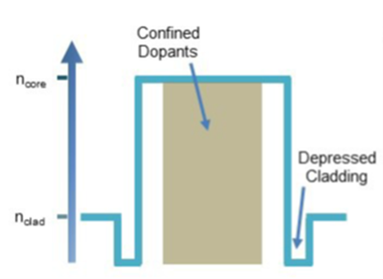
Figure 1: Schematic representation of the LMA fiber refractive index profile
LaserNGN-40mini: Performance Overview
Beyond fiber design, system-level performance ultimately determines the relevance of a technology for real-world applications. Experimental validation is essential to quantify achievable power levels, pulse characteristics, and beam quality.
To evaluate these aspects, the LaserNGN-40mini was tested in a representative ultrashort-pulse chirped-pulse amplification (CPA) configuration, optimized to minimize nonlinear distortion while enabling high peak power operation.

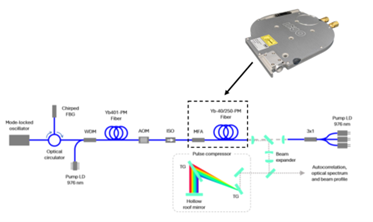
Figure 2 – Schematic representation of the chirped-pulse amplification system (AOM: acousto-optic modulator; ISO: Faraday isolator; MFA: mode-field adapter; LD: laser diode, TG: transmission grating).
CPA architectures are widely used when both high peak power and precision are required. The ultrashort pulse duration limits energy diffusion, enabling sharper feature definition in material processing and reducing collateral effects, an important consideration in both industrial and medical applications.
When integrated into a CPA system, the LaserNGN-40mini delivers the following characteristics:
Key attributes:
- Confined Yb doping and depressed-index cladding for HOM suppression
- High pump absorption enabling short active fiber lengths
- Excellent polarization stability
Demonstrated performance:
- 40 W average output power
- Pulse energies up to ~40 µJ
- Sub-450 fs compressed pulse duration
- Near Fourier-limited pulses with low pedestal
- Beam quality M² < 1.3
These results highlight the suitability of the LaserNGN-40mini for femtosecond CPA systems, nonlinear frequency conversion, and precision micromachining.
Advanced Power Scaling: Enhanced TMI Threshold with LaserNGN-40mini
As laser technologies continue to evolve, increasing power levels remain a central objective. However, pushing these limits introduces new physical constraints that must be carefully managed at both the fiber and system levels.
While larger mode areas help mitigate nonlinear effects, they also increase susceptibility to TMI. This creates a need for design strategies that balance power scaling with beam stability.
Within this context, INO has demonstrated improved TMI mitigation through polarization engineering using a Master Oscillator Power Amplifier (MOPA) configuration based on the LaserNGN-40mini.
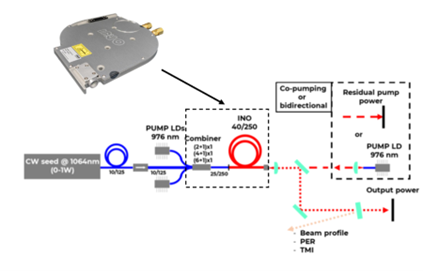
Figure 3 – Schematic representation of the fiber CW testing setup.
Baseline CW Amplifier Results
Using the LaserNGN-40mini seeded at 1064 nm, the following performance was obtained:
- Diffraction-limited beam (M² < 1.2)
- Polarization extinction ratio (PER) ≈ 20 dB maintained up to TMI onset
- 350 W average power output in conventional co-pumping
Polarization-Optimized Injection
The TMI threshold depends on the polarization injection angle relative to the fiber axes. By adjusting this parameter, an approximately 1.5× increase in pump threshold can be achieved. This improvement enables higher repetition rates while maintaining constant peak power, which in industrial environments translates directly into faster processing speeds and increased productivity.
Beam Quality and Stability
In high-power laser systems, performance is not defined solely by output power. Beam quality, stability, and robustness under real operating conditions are equally critical.
Across operating regimes, LaserNGN amplifier modules based on LMA PM fibers demonstrate:
- Near-Gaussian beam profiles
- Stable beam pointing under thermal and mechanical perturbations
- Robust suppression of higher-order modes, including under non-ideal launch conditions
- High polarization extinction ratios
These characteristics are essential for applications requiring consistent and repeatable performance, such as ultrafast pulse compression, nonlinear optics, and coherent beam combining.
Advantages Over Conventional LMA Fiber Amplifiers
When compared with conventional LMA fiber amplifiers, the design approach used in the LaserNGN highlights several practical advantages that directly impact system performance and reliability such as:
- Effective single-mode operation
- Reduced nonlinear phase accumulation
- Shorter fiber lengths enabled by higher absorption
- Improved resistance to photodarkening
- Practical coil diameters, reducing mechanical stress and long-term reliability risks
Together, these factors contribute to more compact, efficient, and robust laser systems.
Why This Matters
The evolution of laser-based systems is closely tied to the ability to control energy with increasing precision. As applications demand higher power levels, maintaining beam quality and system stability becomes a defining challenge.
This is where INO’s LMA PM fiber platform offers several key advantages:
- Higher average power before TMI onset
- Increased pulse energy before nonlinear distortion
- Stable linear polarization
- Near diffraction-limited beam quality
- Industrially robust fabrication (MCVD + solution doping)
- Practical coil diameters (12–16 cm)
These characteristics are particularly important in industrial environments, where performance must be matched with durability, manufacturability, and long-term reliability.
Applications
The combination of high power, beam quality, and stability positions LaserNGN amplifiers for a wide range of advanced applications. These systems are particularly relevant where precision, efficiency, and scalability are required.
High-power ultrafast and picosecond fiber amplifiers
The reduced heat-affected zone enables high-precision material processing, including:
- Micro-drilling
- Thin film patterning
- Semiconductor processing
- Battery and electric vehicle component manufacturing
- Medical applications (surgery, microscopy)
Chirped-pulse amplification (CPA) systems
Supporting high pulse-energy applications such as:
- High-field physics
- Laser-plasma interaction
- Ultrafast science
- High-energy precision processing
Harmonic generation (SHG / THG / UV)
Frequency conversion of 1 µm lasers enables improved absorption and smaller focal spots:
- PCB, semiconductor, and glass processing
- OLED/display manufacturing
- Fluorescence excitation
- Photolithography
- High-contrast marking on plastics
Narrow-linewidth and coherent beam combining architectures
Where coherence and spectral stability are critical:
- Long-range propagation systems
- Advanced defense applications
- Coherent Doppler LiDAR
- Satellite-to-ground communications
- Quantum computing
Conclusion
Advances in fiber design are enabling a new generation of high-power laser systems that combine performance, stability, and scalability. Large mode area polarization-maintaining ytterbium-doped fibers represent a key component of this evolution.
By integrating dopant confinement, depressed-index cladding, and optimized glass chemistry, the LaserNGN platform delivers high beam quality and robust performance across a wide range of operating conditions.
As laser applications continue to expand across industries, these amplifier modules provide a practical foundation for developing next-generation systems that meet both technical and industrial requirements.
